English Courses at Apollo Language Centre, Dublin, Ireland
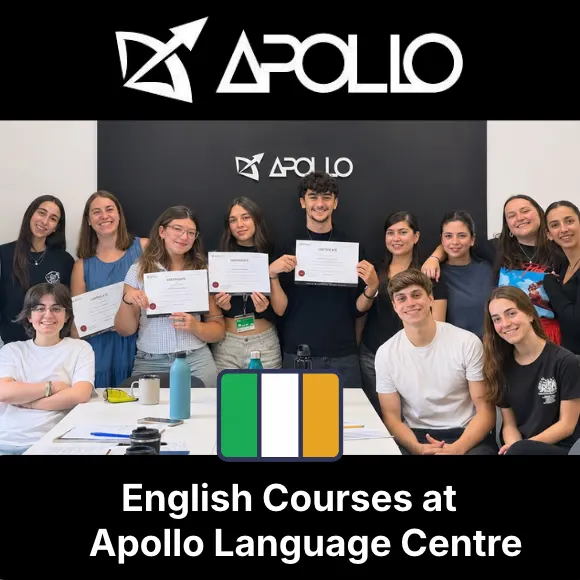
You take your English courses at Apollo Language Centre on Lad Lane, a quiet street in the middle of Dublin, in a building the school rebuilt from the inside in 2023. Two teachers a day, 60-minute hours, classes capped at 16, and more Study Travel Star Awards than any other language school in Ireland.

 1. Tell us your goal
 2. We help you find the right program
 3. We handle the paperwork
 4. Ready to Start
TL;DR: Quick summary
Apollo Language Centre is an English school in the centre of Dublin, at 5 Lad Lane. It’s five minutes on foot from Grafton Street and St Stephen’s Green, right next door to LinkedIn’s European headquarters. Adults come for Real World English, IELTS and Cambridge exam preparation, professional English, an internship, or the 25-week study and work programme that lets non-EU students work in Ireland. Teenagers choose from 4 summer campuses: Sutton Park School on the Howth peninsula, Maynooth University, University College Cork and the University of Limerick. Apollo is accredited by EAQUALS and is a member of IALC and English Education Ireland. Its courses are on the government’s ILEP list, which is what makes a student visa possible.
16 programmes at one school: Real World English (morning, afternoon and Plus), IELTS and Cambridge exam preparation, the 25-week study and work programme, two gap years, professional English in marketing, business and leadership, an internship, teacher training, a young adult summer in Dublin, 4 junior summer campuses across Dublin, Cork and Limerick, and closed group mini stays.
You have two teachers every day. The first lesson works on grammar, structure and vocabulary through reading and writing. The second is all about communication: listening and speaking. That’s two accents and two teaching styles a day. Classes mix nationalities and have a maximum of 16 students, and an hour at Apollo is a full 60 minutes.
- Two teachers a day, max 16 per class
- Beginner A1 to Advanced C1
- 15 classrooms on Lad Lane, Dublin 2
- EAQUALS accredited, IALC and EEI member
ViveCampus
ViveCampus is a benchmark study abroad agency with more than 17 years of experience and over 5,000 satisfied students around the world. We handle your enrolment at Apollo Language Centre for you, we walk you through every step, and our service costs you nothing.


Why do students choose Apollo Language Centre in 2026?
Apollo opened in 2016 and has won 11 Star Awards since. Here’s what’s behind them, in things you can check before you book.

This is what makes Apollo special. Your day is split between two teachers. The first lesson is grammar, structure and vocabulary, worked through reading and writing. The second is communication: listening, speaking, and getting used to saying things out loud before you feel ready. The point is exposure. Two voices, two accents and two ways of explaining the same thing, five days a week. And an hour at Apollo is a full 60 minutes, so 20 lessons a week here means 20 real hours of teaching.
Apollo has won 11 Study Travel Star Awards since 2018. In 2023 it became the first language school in Ireland inducted into the StudyTravel Super Star Hall of Fame. It’s the only provider in the world to win the Star Junior Programme for under 18s award five years running. It won Star New School in 2019, English Language School Europe three times (2022, 2023 and 2024), and in 2024 the Leading Star category, as only the second organisation anywhere to win it. The awards are voted for by the agencies that send students, so they reflect what students actually experience.
For the junior summer, Apollo picks 4 sites built around what a teenager loves to do between lessons. Sutton Park School sits on the Howth peninsula on Dublin Bay, with all-weather pitches and an indoor sports hall. Maynooth University has a 100-acre modern north campus and 19th-century quadrangles on the south. University College Cork is a 180-year-old university, 15 minutes’ walk from the city. The University of Limerick is known as Ireland’s Sporting Campus, with the country’s only Olympic-standard pool, its tallest climbing wall and the largest all-weather sports complex in Europe.
It’s the practical reason so many people choose Ireland. With an EU or EEA passport you can work alongside a course of any length. Everyone else takes the 25-week study and work programme, which comes with a Stamp 2 permission: 20 hours of work a week during term, and 40 hours in June, July, August and from mid-December to mid-January. You also get 10 weeks of holiday on top of the 25 weeks of class. Every Monday afternoon Apollo runs a Job Shop, where a teacher goes through your CV before you print it. Student Services help you book the PPS number appointment you need to get paid.
Lad Lane is a quiet street off Baggot Street, in Dublin’s central business district, and the school was fully renovated at the start of 2023. You get 15 classrooms with TVs, iPads and audio-visual kit, a cafeteria with an outdoor area, quiet study zones and lounges with wifi, a games room and a lift. Grafton Street and St Stephen’s Green are a 5-minute walk, the Charlemont Luas stop is 10 minutes away, and the buses outside cover most of the city. Next door you’ve got LinkedIn’s European headquarters, coffee shops and restaurants.
The Apollo Student App opens the moment your booking is confirmed. It has your pre-arrival information, class details, excursion fact sheets and your daily schedule, and you book your activities right there. Your attendance is on it too, which is handy if you’re on a visa. Behind it there’s a 24-hour emergency phone and WhatsApp line. Every ILEP course comes with learner protection through Aviva Insurance Ireland. Visa students can pay into a PayToStudy escrow account, which holds the fees until the visa decision comes through.
Apollo Language Centre was founded in 2016 by Steven O’Dwyer and Aoife Govern, who still run it day to day. It has been accredited by EAQUALS since 2019 and was re-inspected and re-accredited for a further four years in the most recent cycle. It has been accredited by IALC since 2023 and is a member of English Education Ireland. Its courses are on the Interim List of Eligible Programmes, the government list a course must be on to carry a student visa. Apollo co-founded the Independent Language Schools Group in 2019, is an Erasmus+ and Bildungsurlaub provider, and joined My Erasmus Course in 2025.
Source: Apollo Language Centre

Dublin, a capital city you can still cross on foot
Dublin has about 1.3 million people and sits on the east coast at the mouth of the River Liffey, with mountains behind it and the sea in front. It has a capital’s job market and flight connections, and a centre small enough to walk. Trinity College, Grafton Street, Temple Bar, St Stephen’s Green and the two national museums are all within 20 minutes of each other, and most of them are free.
For a student, the big draw is work. Dublin is the European base for Google, Meta, Amazon, Microsoft, Stripe, LinkedIn and many more, and those offices hire in Spanish, Portuguese, French, Italian and German as well as English. The hospitality sector takes on students all year too. The DART runs along the coast to Howth and Bray, trains and coaches leave from the middle of town, and Dublin Airport is 30 minutes away with flights all over Europe.

What English courses does Apollo Language Centre offer?
16 programmes: 11 for adults at the Dublin school, 4 junior summer campuses across Dublin, Cork and Limerick, and closed group mini stays. Adult classes mix nationalities, have a maximum of 16 students, are taught by two teachers a day, and run from Beginner A1 to Advanced C1.

The course most adults book, and the base for everything else. 20 hours a week, 09:00 to 13:15 Monday to Friday, split between two teachers: grammar, structure and vocabulary in the first lesson, communication in the second. Classes mix nationalities and have a maximum of 16 students. The Cambridge coursebook is included in the fee, and teachers add newspapers, audio and video, lots of it about Dublin and Irish life, so what you learn in class is what you use on the street that afternoon. There’s also a 15-hour afternoon version, 13:45 to 17:00, for students who work in the morning. You take the placement test online before you fly, then a short writing and speaking test on day one.
The same mornings plus Tuesday and Thursday afternoons, 14:00 to 16:30, for 25 hours a week. The afternoons go deeper on the skills you work on in the morning, and they’re what helps you finish a level up. We recommend it to anyone who’s booked a set number of weeks and wants the most out of them, and to anyone whose writing is ahead of their speaking.
20 hours a week that build your English and prepare you for the exam at the same time. You work through all four IELTS components in class, with the timing and task types you’ll meet on the day, and you book the exam itself at a test centre in Dublin. Take it in blocks of 1 to 4, 5 to 8, 9 to 12, or 13 weeks and up. There’s a minimum level, and the online placement test shows whether IELTS is the right target for your dates before you commit, so it’s worth talking about early.
Intensive preparation for every part of the Cambridge exams, 20 hours a week, run as summer courses with Monday starts across June, July and August. First Focus is for students from upper intermediate up; Advanced Focus is for students already at C1. A Cambridge certificate is valid for life, which is why students heading for an Irish or European university often choose it. Tell us which exam session you’re aiming for and we’ll work back to the start date that gives you enough weeks.
The programme that brings most non-EU students to Ireland. 25 weeks of class plus 10 weeks of holiday, with a Stamp 2 permission: 20 hours of work a week during term, and 40 during June, July and August and from mid-December to mid-January. You choose morning Real World English at 20 hours a week or the afternoon course at 15, and you sit a compulsory exam at the end: IELTS, Cambridge First or Cambridge Advanced. You need private medical insurance for the whole stay, which Apollo can arrange. The week-one induction covers the school, the city and exactly what your visa asks of you, including the 85% attendance rule. Visa students can pay into a PayToStudy escrow account, so the fees only go to the school once the visa is granted.
24 or 32 weeks of Real World English with the IELTS exam at the end, so you leave Ireland with an official score. 20 hours a week, 09:00 to 13:15, and long enough to move up two levels if you attend. The exam is booked as part of the programme. It’s the one to look at if you’re between school and university, or between jobs, and want a year that gives you something universities and employers recognise.
Three standalone certificate courses, 2 or 4 weeks each, 20 hours a week in the morning slot. Marketing covers campaigns, digital presence and how to pitch an idea. Business covers meetings, negotiation and writing emails that are direct and polite. Leadership covers managing people, giving feedback and running a meeting. Each one ends with a professional English certificate. They have fixed start dates through the year, and with a month you can do two back to back.
24 weeks in two halves: 12 weeks of Real World English to build your general level, then 12 weeks of the professional courses in marketing, business and leadership. That order is what makes it work, because professional English really clicks once your general English is solid. 20 hours a week throughout, fixed start dates through the year, and you finish with professional certificates as well as a level.
A course followed by a work placement in an Irish company: 2 weeks or more of Real World English or a professional course, then 4 weeks or more in a business. Placements cover more than 20 sectors, including accounting, finance, IT, marketing, healthcare, hospitality and fashion, and they’re matched to your real experience. Placements are unpaid, which is standard in Ireland for this kind of programme, so plan your budget with that in mind. There are two tracks: one for young adults from 16 to 29, and one for adults and professionals aged 30 and over.
A one-week course for non-native secondary school teachers who want to teach their subject through English, or teach English even better. 25 hours in the week, 09:00 to 13:15 Monday to Friday plus Monday to Thursday afternoons. It covers content and language integrated learning (CLIL) and current classroom methodology, with practical material you can use the week you get home. You need upper intermediate English or above. It runs on three fixed weeks a year, and Apollo is an Erasmus+ provider, so teachers from EU schools already have a funding route.
Made for 16 to 19-year-olds who want a grown-up course with the right amount of support. 20 hours of morning class a week at the adult school in Dublin 2, and from 2026 you choose between Real World English, Cambridge First, Cambridge Advanced and IELTS. Afternoons and evenings come as a package: a walking tour of the city on the first Monday, three afternoon visits a week, two dinners or evenings out with Apollo staff, and a full-day trip around the Dublin region every Saturday, all on public transport with a Leap card included. Full board with a host family in a twin or triple room, with a hot lunch at a nearby restaurant Monday to Friday. Sundays are free.
The host family option, on the Howth peninsula on Dublin Bay, at a private secondary school that has welcomed international students for over 20 years. 15 hours of class a week on a zig zag timetable: mornings one week, afternoons the next, so every fortnight brings a fresh rhythm. The site has an all-weather pitch, tennis and basketball courts, an indoor gym, computer labs and an arts and crafts room. Apollo runs its own buses door to door, so getting to school is easy. Each week there are two dinners and two evening activities at school, with the host family collecting afterwards, two full-day excursions, a half day on the Howth cliff walk, and a free Sunday with the family.
The residential option near Dublin, on a campus that’s really two: 19th-century quadrangles on the south side and 100 acres of modern buildings on the north, a 5-minute walk from a proper university town. Students get a single bedroom with a private en-suite in a shared apartment on the north campus, with all meals in the university restaurant. 15 hours of class a week on the zig zag timetable, plus Apollo Focus if they want it: 9 free extra hours a week of project work on leadership, the environment and digital presence. There’s a sports complex with tennis courts, dance studios and outdoor pitches, two full-day excursions a week, an evening programme every night, and a supervised Dublin city trip every Sunday.
Ireland’s second city, at a university founded in 1845 whose 44 acres of grounds run down to the River Lee, a 15-minute walk from the centre of Cork and two and a half hours from Dublin by road. Single room with a private bathroom in a shared apartment, and all meals in the university canteen, with a hot lunch on class days. The sports complex is the star here: tennis courts, a climbing wall, indoor and outdoor running tracks, dance and spin studios and full-size outdoor pitches. 15 hours of class a week, two full-day excursions, and Sundays exploring Cork itself, with free time to shop and look around under Apollo supervision.
For the teenager who lives for sport. The University of Limerick calls itself Ireland’s Sporting Campus, and it has the facilities to prove it: the country’s only Olympic-standard swimming pool and diving board, the tallest climbing wall in Ireland, and the largest all-weather sports field complex in Europe, spread over 138 hectares of green campus along the Shannon, 4 kilometres from the city. Single room with a private bathroom in a shared apartment, and all meals in the university canteen. 15 hours of class a week, two full-day excursions at the weekend, and a supervised trip to Limerick city on changeover day. Arrivals here are Wednesday to Wednesday.
For teachers bringing a whole class. School groups aged 12 to 18 travel from January to May and from September to December, and university and adult groups aged 16 and over come all year, summer included. 15 hours a week of Real World English in a closed class just for your group, up to 18 students, with host family accommodation and meals. You get one free place for a leader in a single room for every 15 students, return airport transfers with an Apollo meet and greet, a welcome pack and student card, the course workbook, a placement test, an Apollo certificate and a walking tour of Dublin with staff. Daily coach transport can be added. 1 week minimum, and stay as long as you like.

Real World English is where most adults start, the 25-week study and work programme is what brings people to Ireland, and the 4 summer campuses are what parents book
Source: ViveCampus

What should you know before enrolling at Apollo Language Centre?
The things worth sorting out before you book, taken from the school’s own handbook and brochure and from what students ask us every week.
Costs, Dates, Application Process and other Considerations
Application Process - Send us the contact form and an advisor comes back with the steps for your country: which documents you need, how long each stage takes, and whether your nationality needs a visa for Ireland. Apollo asks every student to take the online placement test before travelling. That puts you in the right class on your first morning, so your lessons start straight away. If the student is under 18, we put the supervision, the host family and the airport transfer in writing before anything is booked. Preparing and submitting the application is our job.

Dates of the Program - Real World English, Real World English Plus, IELTS Focus, the gap years, the internship and the 25-week study and work programme all start any Monday of the year. These have fixed dates: the Cambridge First and Advanced courses, which run in summer; the professional English certificates in marketing, business and leadership, with start dates through the year; the teacher training week, which runs three times a year; the young adult summer, with Sunday arrivals from mid-June to the end of August; and the 4 junior campuses, with set arrival Sundays (Wednesdays at Limerick). The dates change every year, so tell us the month you have in mind and we’ll confirm the exact dates that still have places.

Length of the Program - Anything from 1 week to a full academic year. Real World English has no upper limit, the exam courses run in blocks from 1 to 13 weeks and up, and the study and work programme is 25 weeks of class inside a longer permission. The gap years are 24 or 32 weeks, the professional certificates 2 or 4 weeks each, and teacher training is 1 week. The junior camps start at 2 weeks, and a mini stay group can come for 1 week or as long as it likes. Give us your dates and we’ll tell you what fits.

Costs - The price depends on the course, the number of weeks, the accommodation and the season, and the weekly rate drops the longer you book. Use the form at the bottom of this page and you get the full quote in writing before you commit to anything: tuition, registration and materials, accommodation, transfers and this month’s promotion. Two costs sit outside the course fee and are good to know early: the entry fee for your exam, and private medical insurance, which non-EU students must have and Apollo can arrange with the booking. Living costs are the bigger number in Dublin. The school’s own guide puts a careful student sharing a room and cooking at home at around 900 to 1,200 euros a month, and a typical student with a private room who eats out sometimes at 1,300 to 1,900. If you’d like a figure before you write to anyone, our cost of studying abroad calculator adds up course, room and weeks.

Health Insurance - Every non-EU student in Ireland must have private medical insurance for the whole stay, and it’s checked when you register with immigration. If you don’t already have a valid policy, Apollo arranges one with your booking. Long bookings also include the learner protection Irish law requires of language schools, provided through Aviva Insurance Ireland for every course on the ILEP list. EU students should bring a European Health Insurance Card, which covers public treatment in Ireland. Repatriation and missed course time aren’t included, so we usually suggest a policy alongside it.

Minimum Age - Adults from 16 for Real World English and the exam courses, and 15-year-olds can join from late May to late August. The professional English certificates and the professional gap year start at 17, and the study and work programme at 18. The young adult summer is for ages 16 to 19, the 4 junior campuses for 11 to 17, and mini stay school groups for 12 to 18. Apollo staff supervise every junior centre the whole time. Parents can choose on the consent form before arrival to keep their child out of photographs, and the child then wears a different coloured lanyard so staff can see it at a glance.

Minimum English Level - None for Real World English, which runs from Beginner A1 to Advanced C1, and none for the junior summer camps. The courses with an entry level are the exam classes (it depends on the exam you’re aiming for), the professional English certificates, and the teacher training week, which asks for upper intermediate. Everyone takes the online placement test before travelling, then a short writing test and a speaking test on the first morning. The average of the two sets your class, and you move up as you progress.

Visa Regulations - It depends on your passport. EU and EEA students just arrive and enrol. Everyone else should check whether their nationality needs a visa before travelling. For any stay over 90 days, you register with immigration after you arrive, and you need to be enrolled on a course of at least 25 weeks on the government’s ILEP list. That’s exactly what the study and work programme is. In your first week, Apollo runs an induction on the visa requirements and prepares the letter you need for your residence permit appointment. We prepare the application from our end and our team handles the translations, at no extra cost.

Working While You Study: - This is why people choose Ireland. With an EU or EEA passport you can work part-time or full-time alongside a course of any length. Without one, you take the 25-week study and work programme, which lets you work 20 hours a week during term and 40 during June, July and August and from mid-December to mid-January. You need a PPS number to get paid, and Student Services help you book that appointment and give you the school letter for it. Every Monday afternoon Apollo runs a Job Shop, where a teacher checks your CV before you print it. And Dublin has the jobs: the European offices of Google, Meta, Amazon, Microsoft, Stripe and LinkedIn all hire in more than one language, and hospitality takes on students all year round.

Accommodation - There are three options for adults, all arranged by the school. A host family is what most students choose and what we recommend for a first stay: a single room, half board with breakfast and dinner on weekdays and all three meals at weekends. Every family is police vetted and inspected in person by Apollo management. Irish families mostly live outside the city centre, so expect around an hour into town on public transport, with the bus or DART a short walk from the door. The Apollo Adult Residence is in Point Village in the Docklands: apartments of up to 8 bedrooms around a shared kitchen and living room, each bedroom with its own shower room, desk and wifi. There’s also a gym, a study room, laundry and a reception staffed 24 hours a day. Hotels and hostels work well for short or late stays. Junior students stay with full board host families or in single en-suite rooms on campus with Apollo leaders living in. Write to us and we’ll price each option for your dates.

Extra Curricular Activities - Apollo has a social programme coordinator whose whole job is this, and next week’s activities go up every Monday. On your first Monday you get an orientation tour of Dublin: the travel pass, the landmarks, the shops and the pubs. After that it’s workshops and visits on weekdays, evening activities and weekend trips, all bookable in the Apollo App. Dublin gives you loads for free: Trinity College, the National Museum, the National Gallery, Temple Bar with its Saturday food and book markets, Croke Park, the Guinness Storehouse, and Howth and Bray on the DART. Glendalough, Powerscourt, the Cliffs of Moher and Galway are all day trips. Many activities are free, and the bigger trips have a small charge.

Airport Pickup - Dublin Airport is about half an hour from the city centre, with direct coaches that stop close to the school. Apollo can add a private transfer to your booking. For junior students arriving into Dublin, Cork or Shannon, transfers are included in the programme and an airport team meets the flight. Adults who’d rather make their own way can take the airport coach, and we’ll send you the route with your confirmation.

First day of classes - Classes start at 09:00 sharp. You’ll have done the online placement test before flying, so the first morning is a short writing and speaking test, a welcome from the support staff and the academic team, and then your class. Break is 11:00 to 11:15 and the morning finishes at 13:15. The door to each lesson closes 15 minutes after it starts, so arriving on time keeps your whole morning. Non-EU students get the date of their visa induction for that same first week, and the orientation tour of the city is on Monday afternoon.

Remember that rent, food and transport usually add up to more than the course. Look at the whole picture when you choose your school
Source: ViveCampus

15 classrooms on a quiet lane in Dublin 2
Apollo is at 5 Lad Lane, a side street off Baggot Street in the central business district, five minutes on foot from Grafton Street and St Stephen’s Green. The building was fully renovated at the start of 2023: 15 classrooms with TVs, iPads and audio-visual equipment, a cafeteria with an outdoor area, quiet study zones, lounges with wifi, a games room and a lift. The Charlemont stop on the green Luas line is 10 minutes away, and a dozen bus routes stop nearby.
Location: 5 Lad Lane, Dublin 2, Ireland
About Dublin
Dublin has around 1.3 million people. It sits at the mouth of the River Liffey, with the Wicklow mountains behind it and Dublin Bay in front, and it’s a capital city you can still cross on foot. Trinity College, the Book of Kells, Temple Bar, Grafton Street, St Stephen’s Green, the National Museum and the National Gallery are all within 20 minutes of each other, and plenty of them are free to walk into. The city has grown more international every year for two decades and eats like it, with the old pubs and traditional music still going strong. For a student, the practical side is great: Dublin is the European base for Google, Meta, Amazon, Microsoft, Stripe and LinkedIn, which all hire in several languages, and hospitality takes on students all year round. Getting out is easy too. The DART runs along the coast to Howth and Bray in half an hour, Glendalough, Powerscourt, Kilkenny, the Cliffs of Moher and Galway are day trips, and Dublin Airport is 30 minutes from the centre with flights across Europe.
The weather in Dublin
Dublin has a mild maritime climate, pleasant all year round. Summers average around 20 degrees and winters about 5, so you can be outdoors in every season. The sky likes to change through the day: sunny at nine, a shower at one, sunny again at four. The school’s advice to new arrivals is spot on: bring layers and a light waterproof jacket, and you’re ready for anything. The best part is the long June and July evenings, still light at ten, which is why the summer social programme works so well.
Dublin in images


A river through the middle, a Georgian city on either side, a coastline 20 minutes away by train and mountains behind. Dublin gives a student plenty to do after class.
Source: Visit Dublin

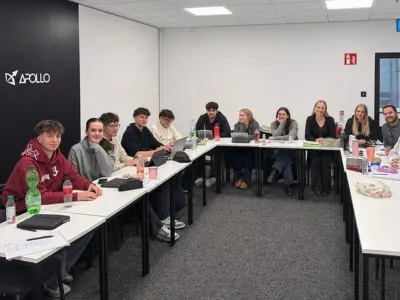
Apollo Language Centre in images



How ViveCampus can help you
A ViveCampus advisor helps you find the right program for you according to your goals, needs and budget.
Our advice is completely free and the process is transparent from start to finish. All payments are made directly to Apollo Language Centre.
When you apply through ViveCampus, you receive support from both the school and our team. We will assist you throughout the application process, the visa, the accommodation and the arrival.
You will also receive an international student card with thousands of discounts, along with other benefits that your educational consultant will explain.
Steps you should follow
1. Tell us your goal A short conversation about your needs, level, budget, dates and what you are looking for.
2. We clarify your doubts We answer all your questions about costs and requirements.
3. We handle the paperwork Application, letter of acceptance and the documents your visa or permit needs.
4. Ready to Start Accommodation confirmed, payments processed, and someone to call whenever you need a hand.


Frequently Asked Questions
What our advisors get asked most before someone books a course at Apollo Language Centre: visas and work, levels and exams, sending a teenager to one of the 4 summer campuses, and what the first week really looks like.

Do I need a visa to study at Apollo Language Centre?
It depends on your passport. EU and EEA students just arrive, enrol, and can work. Everyone else should check whether their nationality needs a visa before travelling. For any stay over 90 days, you register with immigration once you’re here, and you need to be enrolled on a course of at least 25 weeks on the government’s ILEP list. The study and work programme is exactly that. Apollo runs a visa induction in your first week and prepares the school letter you need for your residence permit appointment. Visa students can pay their fees into a PayToStudy escrow account, so the money only goes to the school once the visa is granted. We handle the application from our end, plus the translations it needs, at no extra charge.
How much does Apollo Language Centre cost?
It depends on the programme, the number of weeks, the accommodation and the season, and the weekly rate drops the longer you book. Send us the contact form and the full figure comes back in writing: tuition, registration and materials, accommodation, transfers and any discount for your dates. Two items sit outside the course fee and are good to know early: the entry fee for your exam, and the private medical insurance non-EU students must have, which we arrange with the booking. To start planning right now, our cost of studying abroad calculator gets you close. Our help is free.
What level of English do I need to start?
None for Real World English. Apollo teaches from Beginner A1 to Advanced C1 and welcomes complete beginners, and the junior summer camps take beginners too. The courses with an entry level are the exam classes (it depends on the exam), the professional English certificates, and the teacher training week, which asks for upper intermediate. Everyone takes the online placement test before travelling, then a short writing test and a speaking test on the first morning. The average of the two decides your class, and you move up a class as you improve.
How many students are in a class, and how long is a lesson?
16 is the maximum for adults, and 18 for a closed mini stay group. The lesson length is the number to look at: an hour at Apollo is a full 60 minutes, so 20 hours a week here means 20 real hours of teaching. You also have two teachers every day. The first lesson works on grammar, structure and vocabulary through reading and writing. The second is communication: listening and speaking. That’s two accents and two styles a day, just like the English you’ll hear in real life.
Can I get a job in Dublin while I study?
With an EU or EEA passport, yes: part-time or full-time, alongside a course of any length. Without one, you take the 25-week study and work programme. It comes with a Stamp 2 permission that lets you work 20 hours a week during term and 40 during June, July and August and from mid-December to mid-January. You need a PPS number to get paid, and Student Services help you book that appointment and give you the school letter for it. Every Monday afternoon Apollo runs a Job Shop, where a teacher goes through your CV before you print it. And Dublin has the jobs: the European offices of the big tech companies hire in several languages, and cafés, bars and restaurants take on students all year. We’ll confirm what applies to your nationality before you book a flight.
What makes Apollo’s summer camps special?
There are 4 campuses to choose from, and Apollo is the only provider in the world to win the Star Junior Programme for under 18s award five years running. Sutton Park School on the Howth peninsula is the host family option, with Apollo’s own buses taking students door to door. Maynooth University is residential, with single en-suite rooms on a 100-acre modern campus next to 19th-century quadrangles. University College Cork is residential too, at a university founded in 1845, a 15-minute walk from the centre of Ireland’s second city. The University of Limerick is residential and it’s the place for sport: Ireland’s only Olympic-standard pool, the tallest climbing wall in the country and the largest all-weather sports complex in Europe. All four offer 15 hours of class a week on a zig zag timetable, two full-day excursions a week, activities every night and full Apollo supervision.
What is included in a junior summer booking, and who supervises my child?
The price covers tuition, full board accommodation, the activity and excursion programme and airport transfers. Your child stays either with a full board host family, with Apollo buses to and from the centre at Sutton Park, or in a single room with a private bathroom in a university residence, with Apollo team leaders living on site. Every student joins a team with a named Apollo team leader they see every day. Each week there are two full-day excursions by private coach with staff, an activity every afternoon and evening, and English only in class, in the accommodation and on trips. Your child gets a welcome pack with a student card and lanyard, a personalised course workbook to take home, a weekly assessment and a graded certificate at the end. You get a parent portal with schedules, menus and photo updates, and a 24-hour emergency phone behind all of it.
When can I start at Apollo Language Centre?
Real World English, the Plus course, IELTS Focus, both gap years, the internship and the 25-week study and work programme start any Monday of the year. The rest have fixed dates that change each year. The Cambridge First and Advanced courses run in summer with Monday starts. The professional English certificates in marketing, business and leadership have their own dates through the year. Teacher training runs three weeks a year. The young adult summer has Sunday arrivals from mid-June to the end of August, and the 4 junior campuses have set arrival Sundays (Wednesdays at Limerick). Tell us roughly when you want to travel and we’ll confirm the current dates and what still has places.
What accommodation is available?
Host family, the Apollo Adult Residence, or a hotel or hostel, all arranged by the school. Host families give you a single room and half board: breakfast and dinner on weekdays and all three meals at weekends. Every family is police vetted and inspected in person by Apollo management. Irish families mostly live outside the centre, so plan on around an hour into town on public transport. The residence is in Point Village in the Docklands: apartments of up to 8 bedrooms around a shared kitchen and lounge, each bedroom with its own shower room, desk and wifi. There’s also a gym, a study room, laundry and a reception staffed around the clock. It’s popular, so ask at least a month ahead. Send us the form and we’ll compare the options for your dates.
Where exactly is Apollo Language Centre?
At 5 Lad Lane, Dublin 2, a quiet street off Baggot Street in the central business district. LinkedIn’s European headquarters is right next door, with cafés, restaurants and shops on the doorstep. Grafton Street and St Stephen’s Green are five minutes on foot, the Charlemont stop on the green Luas line is 10, and a dozen bus routes stop nearby. The building was fully rebuilt at the start of 2023 and now has 15 classrooms with TVs, iPads and audio-visual kit, a cafeteria with outdoor seating, quiet study areas, lounges, a games room and a lift. The junior summer centres are at Sutton Park School in Howth, Maynooth University in County Kildare, University College Cork and the University of Limerick.
What else does a course at Apollo include?
The online placement test before you travel, a writing and speaking test on day one, the Cambridge coursebook, and a short test every Friday that your teacher goes through with you. On longer programmes there’s a mid-course test around week 5 or 6 and an end-of-course test at week 10 or 12, a one-to-one tutorial halfway through, and ApolloGO goals sessions on the first Friday of each month. Everyone gets the Apollo Student App, with pre-arrival information, class details, excursion fact sheets, your daily schedule and the activities you book. You finish with a certificate showing your course, your dates and your CEFR level, with the can-do descriptors behind it. A digital copy is kept for 6 years, so you can always get it again.
Is Apollo Language Centre accredited?
Yes. Apollo has been accredited by EAQUALS since 2019 and was re-inspected and re-accredited for a further four years in the most recent four-year cycle. It has been accredited by IALC, the International Association of Language Centres, since 2023, and it’s a member of English Education Ireland, the national body for English language schools. Its courses are on the Interim List of Eligible Programmes, the government list a course must be on to carry a student visa, and student fees on those courses are protected by law through Aviva Insurance Ireland. Apollo is an Erasmus+ provider, co-founded the Independent Language Schools Group in 2019, and has won 11 Study Travel Star Awards since 2018.
What makes Dublin a good place to study English?
Three reasons, and for most people the first one decides it. Ireland lets students work: the 25-week programme in Dublin comes with 20 hours of work a week during term and 40 in the summer. Ireland is in the European Union, so EU students can study and work here freely. And Dublin is a city of about 1.3 million, so you can walk across the centre, you start recognising faces in your local café, and you end up speaking English every day with people you know. It’s a capital city with capital city prices, and earning legally while you study makes the numbers work.
How do I apply to Apollo Language Centre from my country?
Start with the form on this page. A ViveCampus advisor replies in your language with everything that depends on where you live: whether your passport needs a visa, which documents to gather, how the 25-week route works if you want to work, what the total comes to, and which start dates still have places. If the student is under 18, we also put the supervision, the host family and the transfers in writing, so parents can read them before deciding. Just come as you are: the advisor walks you through it all, and it’s free.
What is Apollo Focus, and does it cost extra?
It’s 9 extra hours of teaching a week, it’s free, and it makes the junior residential programmes even better value. At the residential campuses, students can choose Apollo Focus instead of two activity slots: project work on real-world themes like leadership, the environment and digital presence, all about communication. It’s optional, your child chooses it at the school on the first day, and it’s available for the whole stay. For a teenager who’s serious about English, it turns 15 hours of class a week into 24.
What happens if I get sick or something goes wrong while I am there?
Every student and every parent gets a 24-hour emergency phone and WhatsApp number, staffed outside the school’s office hours. For anything minor, a Dublin pharmacist can advise you and sell you over-the-counter medicine without a prescription. For a doctor, EU students with a European Health Insurance Card go to a practice that accepts it and pay nothing for the appointment. Non-EU students pay per visit and claim it back through their insurance, so keep the receipts. Online consultations are available 7 days a week, evenings included, and in an emergency you call 999 or 112. If you’re ill and miss class, email Student Services on the first day, and after 2 days a doctor’s certificate keeps your attendance record clean, which matters if you’re on a visa.
Don’t see your question here? Send it through the form below and a ViveCampus advisor will answer it directly. Asking costs nothing and commits you to nothing.
Source: ViveCampus
Fill out the form below. It only takes 2 minutes to start your journey!

Get a Quote
Fill out the form and a ViveCampus advisor will reach out by email or phone to go over schools, costs and start dates that fit your plan. Our help is free and you are under no obligation.

TODAY
