English Courses in Malta (2026)
English courses in Malta put you on a sunny Mediterranean island where English is an official language, so you practise it from the moment you land. Our partner schools are on the coast, a short walk from the sea, and the whole island is a short bus ride away, from Valletta to the beaches. On an English course of more than 90 days, you can work up to 20 hours a week after your first 3 months. Request a free quote on this page and a ViveCampus advisor will help you choose the school that fits your goals.


 1. Tell us your goal
 2. We shortlist schools
 3. We handle the paperwork
 4. Ready to Start
TL;DR: Quick summary
Malta gives you English classes by the Mediterranean, on an island where English is spoken everywhere. You can study in the morning, swim in the afternoon and spend your weekends in Valletta, Mdina or Gozo.
- Work up to 20 hours a week after your first 3 months, on an English course of more than 90 days
- EU and EEA citizens can study and work in Malta freely
- Courses of up to 90 days on a Schengen visa, or visa-free, depending on your passport
- Partner schools by the sea, all licensed by Malta’s ELT Council
- Free ISIC student card when you apply through ViveCampus
ViveCampus
ViveCampus has helped students study abroad for 15+ years, working with 5,000+ students so far. We help you choose a program, apply to the school, and prepare for arrival: visa paperwork, housing, and what your first week will look like. Every payment goes straight to the school, and our help costs you nothing. We match the school, the course length and the accommodation to what you want from your time in Malta.

Which English schools in Malta should you consider?
These are the English schools we work with in Malta, each with its own size, style and strengths. All of them are licensed by Malta’s ELT Council. Click any school to see its full page, courses and location.
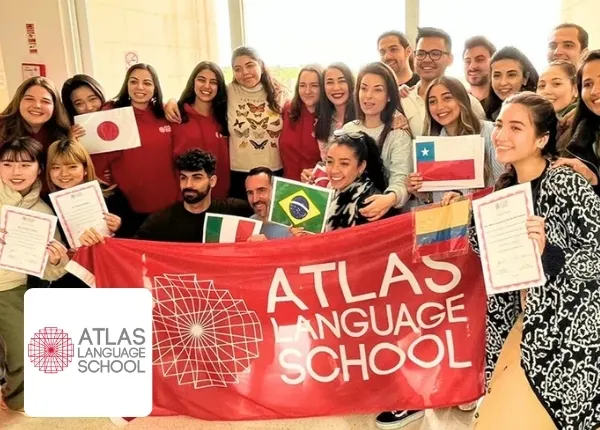
- ATLAS Language School
Atlas, founded in Dublin in 2003, opened its purpose-built Malta school in 2019. It sits in Pembroke, on the edge of St Julian’s, with sea views and a café. Classes have 15 students at most, and General English starts any Monday.
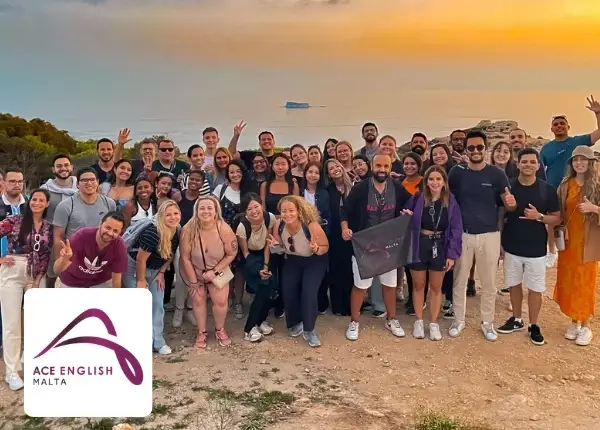
- ACE English Malta
ACE has taught English at St George’s Bay since 2013, on one floor of the Bay Street Complex. General classes average 15 students, Business English has 8 at most, and courses start any Monday. It is licensed by the ELT Council and accredited by EAQUALS.
- English Path Malta
English Path teaches in the heart of St Julian’s, minutes from the bus terminal and a sandy beach. Its 11 classrooms have interactive whiteboards, classes usually have 12 to 15 students, and General English starts every Monday.


Some language schools offer exclusive discounts when you apply through ViveCampus. Contact us for more details.
Source: ViveCampus

Why do students choose Malta?
An island in the middle of the Mediterranean, with English all around you and the sea at the end of the road. It suits students who want real progress in English and a life full of sunshine.

Take an English course of more than 90 days at a licensed school. After your first 3 months of study in Malta, you can work up to 20 hours a week. EU and EEA citizens can work from day one.
English is an official language of Malta, and you hear it all over the island: in shops, on buses and on every road sign. Every coffee you order becomes extra practice.
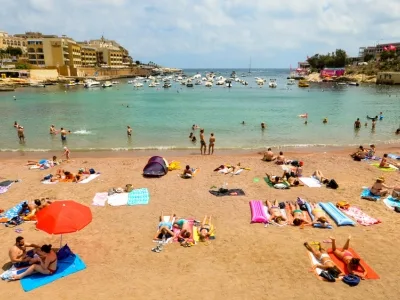
From June to September, afternoons reach 29 to 32 °C, and even January days reach around 16 °C. Spend your free time swimming, sailing and exploring the bays.
Fresh fish, homemade pasta, warm pastries and sun-ripened tomatoes: Mediterranean food is part of daily life. On Sunday, the Marsaxlokk fish market shows off the night’s catch.
Malta sits in the middle of the Mediterranean, south of Sicily, and it is part of the European Union and the Schengen area. Low-cost airlines fly to Malta from cities across Europe, so weekend trips are easy to plan.
The ELT Council, under Malta’s Ministry for Education, licenses the island’s English language schools, and every partner school we work with in Malta is on its list. You study at a school that meets national standards.
On an English course of more than 90 days, you can work up to 20 hours a week in Malta after your first 3 months.

Get to know Malta
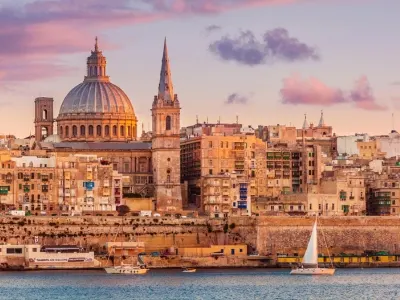
Take a tour of Malta before you arrive: Valletta and its harbour, the walled city of Mdina, the Blue Grotto and the Three Cities across the Grand Harbour, all a short bus ride from your school.
Visit Malta, the island’s official tourism site, is full of ideas for your first weekends, from beaches and boat trips to festivals and nights out.

Malta: The Essentials
The essentials for your first days in Malta, all in one place.



How do you choose the right English program in Malta?
These recommendations come from years of helping students study English in Malta. They draw on our educational consultants, the schools we work with, and above all the students who have lived the experience.
Recommendations and Considerations

Choosing the School - Start with the feel you want around your classes. Some schools are purpose-built with sea views, some are boutique schools with small groups, and some have many classrooms and a busy student lounge. Look at the schools on this page, and our consultants will match you with the one that fits you best.

Choosing the Program - General English builds all your skills, and intensive courses add extra lessons for faster progress. Exam preparation targets an IELTS or Cambridge score, and Business English suits working professionals. Choose the one that matches the goal you have in mind.

Length of the Program - Length shapes what your time in Malta can include. You can start with a single week, and stay as long as a full year. A course of more than 90 days opens the right to work up to 20 hours a week after your first 3 months. So if a job is part of your plan, think about 6 months or more.

Minimum Age - Students of every age are welcome, and each school sets its own entry age, usually 16, 17 or 18 for adult courses. Some schools also run junior programmes for 13 to 17 year olds. Tell us your age, or your son or daughter’s, and we will suggest the right school.
Minimum English Level - You can start from any level, including complete beginner, and apply whenever you are ready. The school places you with a short test, so you join the class that fits you from your very first day.

Visa Regulations - Which document you need depends on your passport and on how long you plan to study. EU and EEA citizens just arrive and enrol. For a course of up to 90 days, you come on a Schengen short-stay visa, or visa-free if your passport allows it. For more than 90 days, you apply for a national long-stay visa (D visa) before you travel. We prepare the paperwork with you.
| Course length | Document usually needed | Cost | Work rights |
|---|---|---|---|
| Any length | None, for EU and EEA citizens | Free | Work freely |
| Up to 90 days | Schengen short-stay visa (C), or visa-free entry for visa-exempt passports | Depends on your passport | Study only |
| More than 90 days | National long-stay visa (D), applied for before you travel | Depends on your country | Up to 20 hours a week after your first 3 months |

Working While You Study - This is one of the best parts of a long stay in Malta. Your English course needs to last more than 90 days, and you travel on a D visa. After your first 3 months of study, you can work up to 20 hours a week. Your job needs an employment licence from Jobsplus, and you can apply for it before your 12 weeks are up. EU and EEA citizens can work freely from day one. Every shift is extra English practice.

Accommodation - Shared student apartments put you with your classmates, close to school and the sea. A host family gives you meals and extra English at the table. Some schools also offer a student residence. Contact us and we will arrange the option that suits you.

Getting Around and Daily Life - Malta Public Transport runs buses across Malta and Gozo, and the Valletta ferry links the capital with Sliema and the Three Cities. On a long course, register for a personalised tallinja card, which makes day routes free under the Government scheme. The Malta Met Office tells you when the beach days are coming, and Visit Malta is full of ideas for your weekends.

Costs Involved - Your budget covers tuition, accommodation, transport and daily life. Everyday prices are kind to a student budget: a cappuccino costs around EUR 2.50 and lunch out around EUR 15. Tuition and accommodation vary by school, course and season. Ask us for a current quote with all the numbers in one place.
| What you pay for | Typical cost (EUR) | Worth knowing |
|---|---|---|
| Tuition | Varies by school and course | Longer bookings usually lower the weekly rate; ask us for a current quote |
| Accommodation | Varies by type and season | Shared apartments, host families and residences, all arranged by the school |
| Public transport | Around EUR 2 a trip | Day routes are free with a personalised tallinja card on a long stay |
| Daily life | Around EUR 15 for lunch out | A cappuccino costs around EUR 2.50 |
| Schengen visa (C) | Depends on your country | For courses of up to 90 days, if your passport needs one |
| National visa (D) | Depends on your country | For courses of more than 90 days |

The biggest part of your budget is usually living costs rather than the course itself. So we help you look at the whole picture when you compare schools.
Source: ViveCampus

Weather in Malta
Malta has long, hot, sunny summers and mild winters, and the sea is never far away. Spring and autumn are warm and bright, perfect for exploring the island after class.
| Month | Season | Min °C | Max °C |
|---|---|---|---|
| January | Winter | 10 | 16 |
| February | Winter | 9 | 16 |
| March | Spring | 10 | 17 |
| April | Spring | 12 | 20 |
| May | Spring | 16 | 24 |
| June | Summer | 19 | 29 |
| July | Summer | 22 | 32 |
| August | Summer | 23 | 32 |
| September | Autumn | 21 | 29 |
| October | Autumn | 18 | 25 |
| November | Autumn | 14 | 21 |
| December | Winter | 11 | 17 |
Even in January, the coolest time of year, afternoons reach around 16 °C. Pack light clothes for the summer and a jacket for winter evenings.
Source: 1991 to 2020 climate normals for Malta International Airport (Luqa)

Cost of living in Malta
Here is what everyday life costs in Malta, so you can plan your budget with confidence. These are typical prices in euros for the things you buy in a normal week. Want to see the whole picture for your stay? Our study abroad cost calculator helps you estimate the total cost.
| What you buy | Typical price (EUR) |
|---|---|
| Cappuccino in a café | around 2.50 |
| Lunch at an inexpensive restaurant | around 15 |
| Fast-food combo meal | around 10.70 |
| Loaf of bread (500 g) | around 1.20 |
| Milk (1 litre) | around 1.20 |
| A dozen eggs | around 3.50 |
| Rice (1 kg) | around 3.30 |
| Chicken fillets (1 kg) | around 8.80 |
| Apples (1 kg) | around 2.90 |
| Bananas (1 kg) | around 1.95 |
| One-way bus ticket | around 2 |
| Mobile phone plan with data, per month | around 24 |
| Gym membership, per month | around 61 |
| Cinema ticket | around 9.90 |
A cappuccino costs around EUR 2.50 and a bus ride around EUR 2, so the island and its cafés are easy on your budget.
Source: Numbeo, Malta cost of living

Where students live in Malta
Malta works like one city by the sea. The schools sit on the coast around St Julian’s, and Malta Public Transport buses link every neighbourhood. These are the areas international students love most.

Malta’s main resort for shopping, cafés and nightlife, with Paceville and the bays of Spinola and St George’s. Several English schools are here, so many students walk to class.
A coastal town that runs into St Julian’s, full of shops and seafront cafés. The ferry from Sliema crosses the harbour to Valletta, and many student apartments are here.
Between Sliema and Msida, with a seafront promenade looking across to Manoel Island and Valletta. A popular area for shared student apartments.
A quiet residential area on the edge of Paceville, close to the life of St Julian’s. Many students rent apartments here.
Home to the University of Malta’s main campus and the yacht marina on Msida Creek. The Airport Direct TD3 bus stops here, and student apartments are close by.
Malta’s capital, a World Heritage City built by the Knights of St John. Live among Baroque palaces, churches and cafés, a short ferry ride from Sliema.
The school you choose can arrange your apartment, host family or residence, and buses link every area on this list.
Source: ViveCampus

Getting from Malta International Airport
Malta International Airport sits in Luqa, in the south of the island, and you have several easy ways to reach your new home the day you land.

The easiest start. Book a transfer through the school, and a driver meets you outside the customs area and takes you straight to your accommodation.

Airport Direct TD2 runs every 30 minutes to St Julian’s and Pembroke. TD3 runs every 30 minutes to St Julian’s, Sliema, Gżira and Msida. The buses have USB charging, free wifi and space for your luggage.
TD4 runs every 30 minutes to Valletta and the Gozo Fast Ferry. Pay on board with cash or a contactless card, or buy a travel card at the Malta Public Transport office in the arrivals hall.
Malta Taxi provides the official taxi service, and you can work out your fare before you travel. A comfortable choice when you land late or carry plenty of luggage.
Send us your flight details when you book and we will help you arrange your airport transfer with the school.
Source: Malta Public Transport and Malta International Airport

Things to do in Malta
Between classes and at weekends, Malta puts a Baroque capital, a walled medieval city, turquoise bays and a sister island within easy reach. These are favourites with international students.
Main attractions
Events through the year
Malta celebrates all year round. Here is when each big event comes around, so you can plan your stay to catch your favourites. The organisers publish the exact dates each year.
| Event | Time of year | What to expect |
|---|---|---|
| Carnival | February | Colourful floats and costumes fill Valletta, and the party carries on late into the night in Paceville |
| Holy Week and Easter | March or April | Processions through Valletta and the towns, and on Easter Sunday the statue of the Risen Christ is carried at a run |
| Village festas | Late May to September | Almost every weekend a town celebrates its patron saint, with festoons, food stalls, bands and fireworks |
| Malta International Jazz Festival | July | 3 nights of jazz by the Grand Harbour at Ta’ Liesse in Valletta, with concessions for students |
| Isle of MTV Malta | Summer | One of Europe’s biggest music festivals, with international pop stars and crowds of more than 50,000 people |
| Notte Bianca | October | A night when Valletta’s palaces, museums, streets and squares fill with art, music, theatre and dance |
| Christmas | December | Cribs all over the island, candlelit carols at St John’s Co-Cathedral and the annual pantomime at the Manoel Theatre |
Malta is small, so every place on this page makes an easy day trip with your classmates.
Source: visitmalta.com, the official site of the Malta Tourism Authority

What do students say about studying English in Malta?
Reading about other students’ experiences is one of the best ways to picture your own time in Malta. These students studied English here with ViveCampus, and their stories show the friendships, the progress and the confidence that come with the experience.

Choosing Malta to study English was the right choice. I wanted to learn English in a destination with great weather and an international environment, and Malta was perfect. I’m also very grateful to ViveCampus for all their help and support throughout the process.

Studying English in Malta was one of the best decisions I have made. I chose Malta because it is safe, beautiful and full of international students. I improved my English a lot and enjoyed every moment of the experience.
Students share their experience of studying English in Malta.
Source: ViveCampus

Malta in images


ViveCampus can help you
A ViveCampus advisor reviews your needs, age, goals, English level, budget and start date. Then we narrow Malta’s schools down to the one that fits you best.
Our advice is completely free, and the process is 100% transparent. You make all payments directly to your chosen school.
When you apply through ViveCampus, you receive support from both the school and our team. We will guide you through the application, the visa requirements and your arrival in Malta.
Students who apply to an English program through ViveCampus also receive the ISIC International Student Identity Card, recognised worldwide. It gives you great discounts across Malta on travel, attractions, food and shopping.
Steps you should follow
1. Tell us your goal A short conversation about your needs, level, budget, dates and what you are looking for.
2. We shortlist schools You get a written comparison of two or three real options, with total costs.
3. We handle the paperwork Application, letter of acceptance and the documents your visa needs.
4. Ready to Start Accommodation confirmed, payments processed, and someone to call whenever you need a hand.

Frequently Asked Questions
The questions students ask our advisors most often before booking an English course in Malta, covering work, visas, costs, schools and daily life. Wherever a rule applies, we point you to the official source.

Can I work while I study English in Malta?
Yes, on a long enough course. With an EU or EEA passport, you can work freely. With any other passport, you need an English course of more than 90 days and a D visa. After your first 3 months of study in Malta, you can work up to 20 hours a week. Your job needs an employment licence from Jobsplus, and you can apply for it before your 12 weeks are up. We can help you plan a course that qualifies.
Do I need a visa to study English in Malta?
It depends on your passport and your course length. EU and EEA citizens just arrive and enrol. For up to 90 days, you come on a Schengen short-stay visa or visa-free, depending on your passport. For more than 90 days, you apply for a national long-stay visa (D visa) before you travel, and that includes visa-exempt passports. We prepare the paperwork with you.
How much does it cost to study English in Malta?
Your budget depends on the school, the course length and how you choose to live. Everyday life is kind to a student budget: a cappuccino costs around EUR 2.50 and a bus ride around EUR 2. Tuition and accommodation vary by school and season, so we give you a personalised quote with all the numbers together. Send us the contact form for your quote.
Do people in Malta really speak English?
Yes, every day. English is an official language of Malta, and you see it on every road sign. The pharmacist, the bus driver and the person at the next table all use it. So every coffee, bus ride and chat after class becomes English practice. Explore ideas for your stay on Visit Malta.
Which English schools do you work with in Malta?
You can see every school we work with in Malta on this page, each with its own style: purpose-built schools with sea views, boutique schools with small groups, and schools with a student residence. All are licensed by the ELT Council. Tell us what you love and we will help you choose.
Do I need a certain level of English to start?
Not at all. Our partner schools in Malta welcome every level, including complete beginners, and you can apply whenever you are ready. You take a short placement test so you join the class that fits you from your first day.
How old do I need to be to study English in Malta?
Each school sets its own entry age, usually 16, 17 or 18 for adult courses, and some schools run junior programmes for 13 to 17 year olds, with supervision and activities. If you are under 18, we put the supervision and accommodation in writing before you book.
Where will I live while I study?
Many students choose a shared student apartment near school, with classmates as flatmates. A host family adds meals and extra English every day, and some schools also offer a student residence. Contact us and we will arrange the option that suits you.
What is the ISIC card and how do I get it?
The ISIC International Student Identity Card is recognised worldwide and gives you discounts on travel, attractions, food and shopping. Students who apply to an English program in Malta through ViveCampus receive it. It is a great way to make your budget go further while you explore the islands.
Why apply through ViveCampus?
Our advisors know every Malta school on this page, and our help is 100% free for you. We compare your options in writing, prepare the visa paperwork with you and stay with you until you arrive. You pay the school directly, and some schools offer exclusive promotions when you apply through ViveCampus.
Where can I check that a school is officially recognised?
The ELT Council, under Malta’s Ministry for Education, licenses English language schools and publishes the list. Every school we work with in Malta is on it, so you study at a school that meets national standards.
Don’t see your question here? Send it through the form below and a ViveCampus advisor will answer it directly. Asking costs nothing and commits you to nothing.
Source: ViveCampus
Fill out the form below. It only takes 2 minutes to start your journey!

Get a Quote
Fill out the form and a ViveCampus advisor will reach out by email or phone. Together you go over the schools, costs and start dates that fit your plan. Our service is 100% free for you.

TODAY
