English Courses at Original Campus Melbourne, Australia
Original Campus is an English school in Docklands, right inside Melbourne’s free tram zone. Your English courses at Original Campus Melbourne take place on one campus, in small student-centred classes. And you live in a city ranked among the most liveable in the world.


 1. Tell us your goal
 2. We help you find the right program
 3. We handle the paperwork
 4. Ready to Start
TL;DR: Quick summary
Original Campus teaches English on a single campus on La Trobe Street, in Docklands. It is a few tram stops from the centre of Melbourne. The school is registered to teach international students in Australia under CRICOS 03668J. You choose from 3 courses, all 20 hours a week on campus, and all start any Monday of the year. Every lesson is built to get you talking. The same campus also runs nationally recognised vocational diplomas, and many students move on to one once their English is ready.
You have 3 courses to pick from. General English builds your everyday confidence. Cambridge preparation gets you a certificate that never expires. IELTS and PTE preparation gets you the score your university or visa asks for. Free extras run alongside all of them, from pronunciation workshops to the Job Ready Programme.
Lessons are student-centred, so you spend the hour speaking. It is the reason most students give for choosing Original Campus.
- General English runs from 4 to 60 weeks
- 20 hours a week, in the morning, midday or evening
- Start any Monday, no entrance exam for General English
- One campus in Docklands, inside the free tram zone
ViveCampus
ViveCampus is a leading study abroad agency with more than 17 years of experience and over 5,000 happy students around the world. We handle your Original Campus enrolment for you, guide you at every step, and our service costs you nothing.


Why do students choose Original Campus in 2026?
Original Campus gives 6 reasons of its own for studying there. Here they are, with what each one means for your week.

Lessons at Original Campus are student-centred. They are built around your participation and your curiosity, because engaged students reach their goals. English is the language of the whole building, in class and around campus. Translators are on hand whenever you need one. From your first week, you are talking, asking questions and joining in.
The campus is open plan, with the feel of a startup office. It suits Docklands, a part of town built around new businesses. Inside you get multimedia classrooms, free Wi-Fi throughout, a library and study area, and a student kitchen with a coffee machine. There is also a lounge for the hours between classes. Cafes, restaurants, shops and a gym are on the doorstep. Marvel Stadium and the New Quay waterfront are a short walk away.
Original Campus hires qualified, experienced teachers who focus on your goals. They enjoy helping you reach your potential. Your teacher knows what you are working towards and plans your lessons around it.
Original Campus helps you grow as a person as well as in English. You get to know Australian culture and get ready for what comes next. One-to-one Development Sessions help you work on your own goals. The Job Ready Programme is built for students who want to work here. And careers counselling maps out your next step, including the school’s own business, leadership and project management diplomas.
A dedicated team is ready to answer your questions, help with any challenge and give you advice. It starts before you arrive, with pre-departure advice and an airport pickup. Then it carries on with orientation, welfare support and help settling into the city.
Original Campus is a friendly, supportive place to learn. Social and cultural activities make your stay bigger than the timetable. The Social Club runs excursions and events around the city. Networking Events bring in guest speakers and local contacts.
Original Campus is a registered training organisation, RTO 45322. It is also registered on CRICOS under provider code 03668J, which lets it teach international students on a student visa. Both numbers are public, so you can look the school up yourself.
Source: Original Campus

A city that keeps being called the world’s most liveable
Melbourne is consistently ranked among the most liveable cities in the world. About half its residents were born overseas or have a parent who was. That mix gives you great food, a place where every accent feels at home, and friends from all over the world.
Docklands puts all of it within easy reach. The free tram zone covers the campus and the whole central city, so your daily travel is free. The laneways, galleries, sport and coffee Melbourne is known for are a short ride away.

What English courses does Original Campus offer?
All 3 courses run on the same campus, with the same teachers, for 20 hours a week. You shape your week with the timetable. Original Campus runs morning, midday and evening classes. So you can fit study around a job, your family or the hours you work best. A placement test before classes starts you at the right level. And you can move between courses as your goal changes.

This course gets you using English confidently in real life, through everyday topics and situations. You study 20 hours a week on campus, for 4 to 60 weeks. There is no entrance exam and no minimum level, so complete beginners are welcome. The placement test simply decides which class you join.
For a certificate that never expires, recognised by employers and universities everywhere. You get 20 hours a week focused on the exam, for 12 to 26 weeks. The length depends on which exam you sit and your starting level. The placement test shows whether you are ready. If you need a little more time, you begin in General English and move across.
For the score your university, employer or visa application asks for. You get 20 hours a week of exam skills and technique. Book 4 weeks for a final polish, or up to 42 if you are building up from a lower level. The placement test shows whether you start here or in General English first.
Original Campus also runs nationally recognised vocational qualifications on this campus. They include a Diploma of Business, a Diploma of Social Media Marketing and a Diploma of Project Management. Entry is IELTS 6.0, so many students take an English course here first. For the full list of 6 qualifications and what each one involves: Original Campus professional programs

General English is where most international students begin, and the exam courses are where they go next
Source: ViveCampus

What should you know before applying to Original Campus?
These notes come from our advisors, from Original Campus’s own materials and from students who have already been. They are what people most want to know before they book.
Costs, Dates, Application Process and other Considerations
Application Process - Complete the contact form and an advisor will send you the exact steps for your country. That covers which documents you need, how long each stage takes and how the Australian student visa application works. Before classes begin, you sit a short placement test, and that sets your level. So there is no certificate to send in advance. We prepare and submit the application for you.

Dates of the Program - Every course starts on a Monday, any week of the year. When the Monday is a public holiday, you start on the Tuesday. Teaching runs in 10-week cycles, with a 2-week break after each one. That gives your year a steady rhythm. You also choose your timetable, Monday to Friday: mornings from 8.00 to 12.10, middays from 12.30 to 4.40, or evenings from 5.15 to 9.30. Tell us the month you are aiming for and we will confirm what is open.

Length of the Program - General English runs from 4 to 60 weeks, Cambridge preparation from 12 to 26, and IELTS and PTE preparation from 4 to 42. Each one is 20 hours a week on campus. Not sure how many weeks you need? Your placement test result is the best guide, and we go through it with you before you commit.

Costs - Your price depends on the course, how many weeks you book and when you travel. Longer bookings bring the weekly rate down. You pay at most half the tuition before you start, and the rest term by term. That makes budgeting easier, especially from another currency. Complete the contact form at the end of the page and we will send you a full quote before you commit to anything. It includes tuition, enrolment, materials and that month’s promotion. For living costs, the school’s student handbook budgets around 400 to 800 Australian dollars a week. That covers rent, transport, phone and groceries, or about 20,000 to 25,000 a year. These figures change over time, so use them as a guide. Our study abroad budget calculator puts tuition, accommodation and living costs side by side.

Health Insurance - Overseas Student Health Cover (OSHC) is compulsory on an Australian student visa. It has to cover the full length of your visa, beyond the course itself. We arrange it with your enrolment, so you are covered from the day you arrive. On a Working Holiday or visitor visa you do not need OSHC, but travel insurance is still a good idea.

Minimum Age - All 3 courses are adult courses and take students from 18. Asking for someone younger? Tell us their age and what they want to achieve. We will suggest schools in Melbourne or elsewhere in Australia that are set up for under 18s.

Minimum English Level - None for General English. Complete beginners are welcome, with no entrance exam and nothing to send in advance. The Cambridge and IELTS courses have an entry level, and the placement test checks it. If you need more time, you start in General English and move across when you are ready. So you always study in the class that fits you.

Visa Regulations - It depends on how long you stay. You can often do a short course on a visitor visa or an eTA. A Working Holiday visa lets you study for a few months. For longer full-time study you need a student visa (subclass 500), which requires at least 20 hours of class a week. Original Campus courses are 20 hours, so they qualify. Australia is one of our specialities. We prepare and lodge the application, and our team does any translations at no extra cost.

Working While You Study: - Yes, in most cases. On a student visa you can currently work up to 48 hours per fortnight while your course runs, with no limit during scheduled breaks. The Australian government reviews this from time to time, so we check the figure for your start date before you fly. Original Campus’s Job Ready Programme gets you ready to work in Australia. And its Networking Events introduce you to local employers.

Accommodation - You have 3 options: homestay with an Australian family, a student residence or a shared apartment. The right one depends on how independent you want to be in your first weeks and on your budget. Prices change with the season. Ask us for a quote and we will lay out the options with real prices for your dates.

Extra Curricular Activities - Free workshops run every day from 12.30. They cover pronunciation, public speaking, conversation club and career development. You can join as many as you like on top of your 20 hours. The Social Club organises excursions and events around the city, so you keep practising after class. Development Sessions give you one-to-one coaching on your own goals. The Job Ready Programme is for students who want to work here. Networking Events bring in guest speakers and local contacts. And every week there is a graduation ceremony, a proud moment when it is your name being read out.

Airport Pickup - You can add an airport transfer, and we arrange it together with your accommodation. Original Campus suggests landing about 2 weeks before orientation. That gives you time to open a bank account, get a SIM card and find your local supermarket. For a first arrival the transfer is well worth it. After a long flight, someone is there to meet you by name.

First day of classes - Orientation happens before your first class. It covers your support services, health and emergency contacts, and the campus and its resources. You also go through your visa conditions, your rights at work and who to talk to whenever you need a hand. Then you get your placement result, your timetable and a tour. Bring your passport and your health cover details.

Keep in mind that the biggest cost is usually not the course itself, but living costs. So before you choose the cheapest school, look at the whole picture
Source: ViveCampus

Great Location in Melbourne, Australia
Melbourne is why many students choose Victoria, and Docklands is one of the easiest parts of it to live in. Original Campus sits inside the free tram zone. So the whole central city, including Federation Square and Flinders Street Station, is free to reach.
Address: 207/673 La Trobe Street, Docklands VIC 3008, Australia
About Melbourne
Melbourne is Australia’s second largest city, home to about 5 million people. It regularly tops the lists of the world’s most liveable cities. About half the people here were born overseas or have a parent who was. So the food is excellent and every accent feels at home. It is also one of Australia’s biggest student cities. The University of Melbourne, Monash and RMIT are all here, and in term time you can feel it. Melbourne is a UNESCO City of Literature and a major centre for street art, music and theatre. It is home to the Melbourne Cricket Ground, the National Gallery of Victoria and the State Library of Victoria. You also have the World Heritage listed Royal Exhibition Building. Australian rules football was invented here, and the city hosts the Australian Open and the Formula 1 Grand Prix. For you as a student, that means part-time work, public transport that takes you places, and free trams around the centre. Docklands, where the campus is, sits on the water at the western edge of the centre.
Weather in Melbourne
Melbourne’s weather changes fast, and locals will tell you about 4 seasons in one day before your first week is over. Summer, from December to February, is warm and dry. It is usually in the mid 20s, with hot spells well above 30°C. Autumn, from March to May, is the season most people love best: mild, calm, and the parks change colour. Winter, from June to August, is cool and mild, usually in the low teens by day, with grey spells and rain. It never snows in the city. Spring, from September to November, is the most changeable, with warm afternoons and sudden cool changes. Bring a light jacket and layers, and you will be comfortable in any month.
Melbourne in images
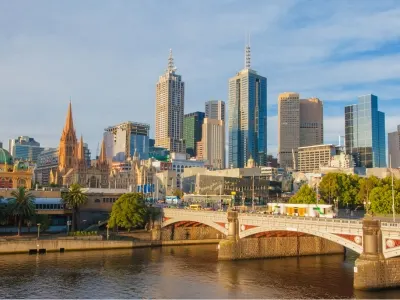


Trams go everywhere, the laneways are full of coffee and street art, and the river is yours to walk along after class. The sporting calendar brings the whole city out. Melbourne rewards you for exploring it, and the free tram zone makes exploring free.
Source: What’s On Melbourne

What do students say about studying at Original Campus?
Two students who have already done it, in their own words. Both came a long way to get here. And both talk about the same things: the teaching and the people they met.

My experience studying English at Original Campus in Melbourne has been fantastic. I love the classes, the facilities, and especially the teaching methodology they use. I’ve improved my English so much, in a way I never thought possible. I’m really happy with my experience and would definitely recommend Original Campus to anyone who wants to improve their English while having an amazing experience in Australia.

I’m very grateful to Original Campus and ViveCampus for all their support throughout my experience. The classes have really improved my English, and the extracurricular activities have helped me meet new people and practice outside the classroom. Now that my English has improved, I’m working part-time as an assistant at a photography studio here in Melbourne. It’s been an amazing experience! I fully recommend it.
Student testimonials from Original Campus share students’ experiences at the language school.
Source: ViveCampus

Original Campus in images



How ViveCampus can help you
A ViveCampus advisor helps you find the right programme for you, based on your goals, needs and budget.
Our advice is completely free, and the process is 100% transparent. You make all your payments directly to Original Campus.
When you apply through ViveCampus, you get support from both the school and our team. We help you through the application, the visa, the accommodation and your arrival.
You also get an international student card with thousands of discounts, plus other benefits your advisor will explain.
Steps you should follow
1. Tell us your goal A short chat about your needs, level, budget, dates and what you are looking for.
2. We clarify your doubts We answer all your questions about costs and requirements.
3. We handle the paperwork Application, letter of acceptance and the documents your visa or permit needs.
4. Ready to Start Accommodation confirmed, payments processed, and someone to call whenever you need a hand.


Frequently Asked Questions
These are the questions students ask our advisors most before booking a course at Original Campus. They cover entry, levels, costs, work rights and what your first week looks like.

Do I need a visa to study at Original Campus?
It depends on how long you stay. You can often do a short course on a visitor visa or an eTA. A Working Holiday visa lets you study for a few months. For longer full-time study, you need a student visa (subclass 500), which requires at least 20 hours of class a week. All 3 Original Campus courses are 20 hours, so they qualify. Australia is one of our specialities. We prepare and lodge the application for you, and our team does any translations your file needs at no extra cost.
How much does Original Campus cost?
It depends on the course, how many weeks you book and the time of year. Longer bookings lower the weekly rate. Two things help when you budget. You pay at most half the tuition up front, and the rest term by term. And if your student visa is refused, Original Campus refunds the unused prepaid fees, keeping only the enrolment fee. Your fees are also protected by the Australian government’s Tuition Protection Service. Complete the contact form and we will send you a full quote with tuition, enrolment and materials. It comes with the best discount available for your dates. You can also work out a rough total with our budget calculator for studying abroad. Our advice is free.
Do I need a certain level of English before I start?
Not for General English. Complete beginners are welcome, with no entrance exam and no certificate to send. Everyone takes a placement test before classes begin, and it decides which class you join. Cambridge and IELTS preparation have an entry level, which the placement test confirms. If you need more time, you start in General English and move across when you are ready.
How big are the classes?
Ask us and we will get the current average class size for your course and start date in writing before you book. Every class follows the Original Approach. Lessons are built around your participation, and your teachers plan around your goals. So you speak in class every day from your first week.
Can I choose what time of day I study?
Yes. Original Campus runs classes in the morning, at midday and in the evening, Monday to Friday. Mornings run from 8.00 to 12.10, middays from 12.30 to 4.40 and evenings from 5.15 to 9.30. So you can fit your 20 hours around a job, your family or the hours you study best. Every timetable follows the Original Approach, with student-centred lessons where you talk in class every day.
When can I start at Original Campus?
Any Monday of the year, for all 3 courses, or the Tuesday when the Monday is a public holiday. That includes exam preparation, so you can start Cambridge or IELTS whenever it suits you. Tell us your dates and we will confirm what is open and how many weeks to book.
Am I allowed to work during the course?
Yes, on a student visa. You can currently work up to 48 hours per fortnight while your course runs, with no limit during scheduled breaks. The Australian government reviews this from time to time, so we check the figure for your start date before you fly. Original Campus’s Job Ready Programme helps you with the practical side. And its Networking Events introduce you to local employers and guest speakers.
Is there a minimum age?
Yes. All 3 courses are adult courses and take students from 18. Asking for someone younger? Tell us their age and what they want from the trip. We will suggest schools in Melbourne and elsewhere in Australia that are set up for under 18s, with the supervision they need.
What accommodation is available?
Homestay with an Australian family, a student residence or a shared apartment. Homestay is the easiest way to land if it is your first time living abroad. Your room and meals are sorted, and you speak English from breakfast. A residence gives you more independence. A shared apartment works well once you know the city. Prices change with the season, so ask us for a quote and we will include real prices for your dates.
Where exactly is Original Campus?
At 207/673 La Trobe Street, Docklands, on the western edge of central Melbourne. The campus is open plan, with the feel of a startup office. It has multimedia classrooms, a library and study area, a student kitchen and a lounge. Getting there is easy. Southern Cross Station is the closest train station. Trams 86, 30 and 35 stop at Marvel Stadium, and trams 70 and 75 at Central Pier. Buses 219 and 216 stop on Spencer Street, and there is bike parking on La Trobe Street. The campus is inside Melbourne’s free tram zone, so trams around the whole central city are free.
What is included besides the classes?
Plenty, at no extra cost. Free workshops run every day from 12.30, on pronunciation, public speaking, conversation club and career development. The Social Club organises excursions and events, so you use your English all over the city. Development Sessions give you one-to-one coaching on your own goals. The Job Ready Programme is for students who want to work here. Networking Events bring in guest speakers and local contacts. You also choose mornings, middays or evenings. And every week there is a graduation ceremony for students finishing a level.
Is Original Campus accredited?
Yes. Original Campus is a registered training organisation, RTO 45322. It is registered on CRICOS under provider code 03668J, the Australian government register of providers allowed to teach international students. That registration is what lets you study its courses on a student visa. Both numbers are public, so you can check them yourself. The same registration covers its vocational qualifications, so you can go on to a diploma with the same provider.
What is an ELICOS course, and is Original Campus registered for it?
ELICOS is the Australian government’s name for intensive English courses for overseas students. Every full-time English course on a student visa falls under it. The letters stand for English Language Intensive Courses for Overseas Students. All 3 Original Campus English courses are ELICOS courses. The school is registered to deliver them under CRICOS Provider Code 03668J, as RTO 45322. You can look both numbers up on the Australian government’s CRICOS register and see the registration for yourself.
How do I apply to Original Campus from my country?
Start with the form on this page. A ViveCampus advisor then contacts you in your own language with everything for your case. That means the documents your country needs, how long each step takes and how the Australian student visa application works. You also get the full total and the Mondays that still have places. You need nothing ready before talking to us, and our advice is free from start to finish.
Can’t see your question here? Send it through the form below and a ViveCampus advisor will answer you directly. Asking costs nothing and commits you to nothing.
Source: ViveCampus
Fill out the form below. It only takes 2 minutes to start your journey!

Get a Quote
Fill out the form and a ViveCampus advisor will get in touch by email or phone to go over schools, costs and start dates that fit your plan. Our help is free and you are under no obligation.

TODAY
